Playstation Blackout : Cause and Deflect
The debate surrounding the PlayStation Blackout has sparked a much larger conversation about the future of gaming, particularly the growing shift from physical media to digital ownership. While opinions on the issue are understandably divided, questions arise when a handful of voices are presented as representative of a gaming community made up of hundreds of millions of players. With PlayStation alone reporting more than 125 million monthly active customers, the conversation deserves to look beyond a single perspective and examine what gamers are actually saying, what is at stake, and where the industry may be headed.
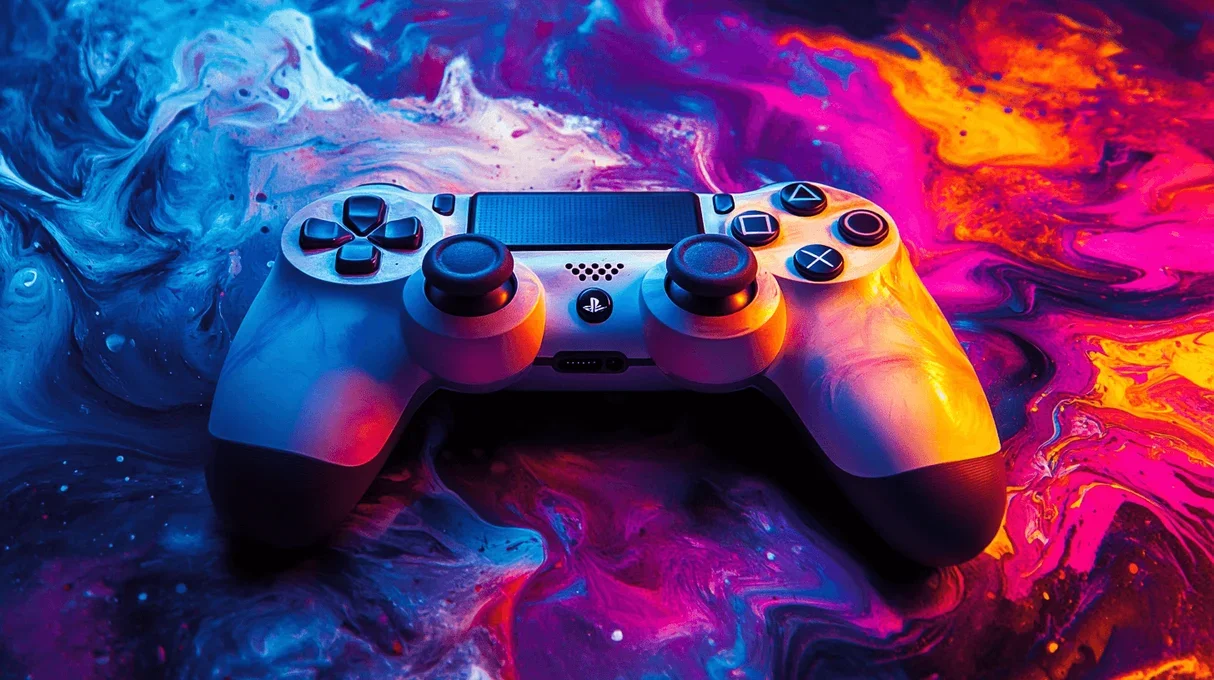
Playstation 5 Controller Mural , Image courtesy of lacasadellafibra
Gaming as a whole is a hobby that most of society considers childish. If you have never enjoyed a modern game from start to finish, you would be inclined to believe that it is still plumbers climbing after gorillas with hammers. There are entire worlds crafted, stories woven, and even entire ecosystems thriving within gaming servers, and it is not wrong to say that there is a game out there for everyone to enjoy—even those who cannot stand games.
Yet, with all the people bucking up against gamers lately, it seems odd that the ones doing the most damage to the community are, in fact, gamers. Sure, large companies like Sony, Microsoft, and Nintendo do not do themselves any favors with the decisions that have been made as of late. It still seems like the worst thing you can do in today's world is disagree with what any corporation does.
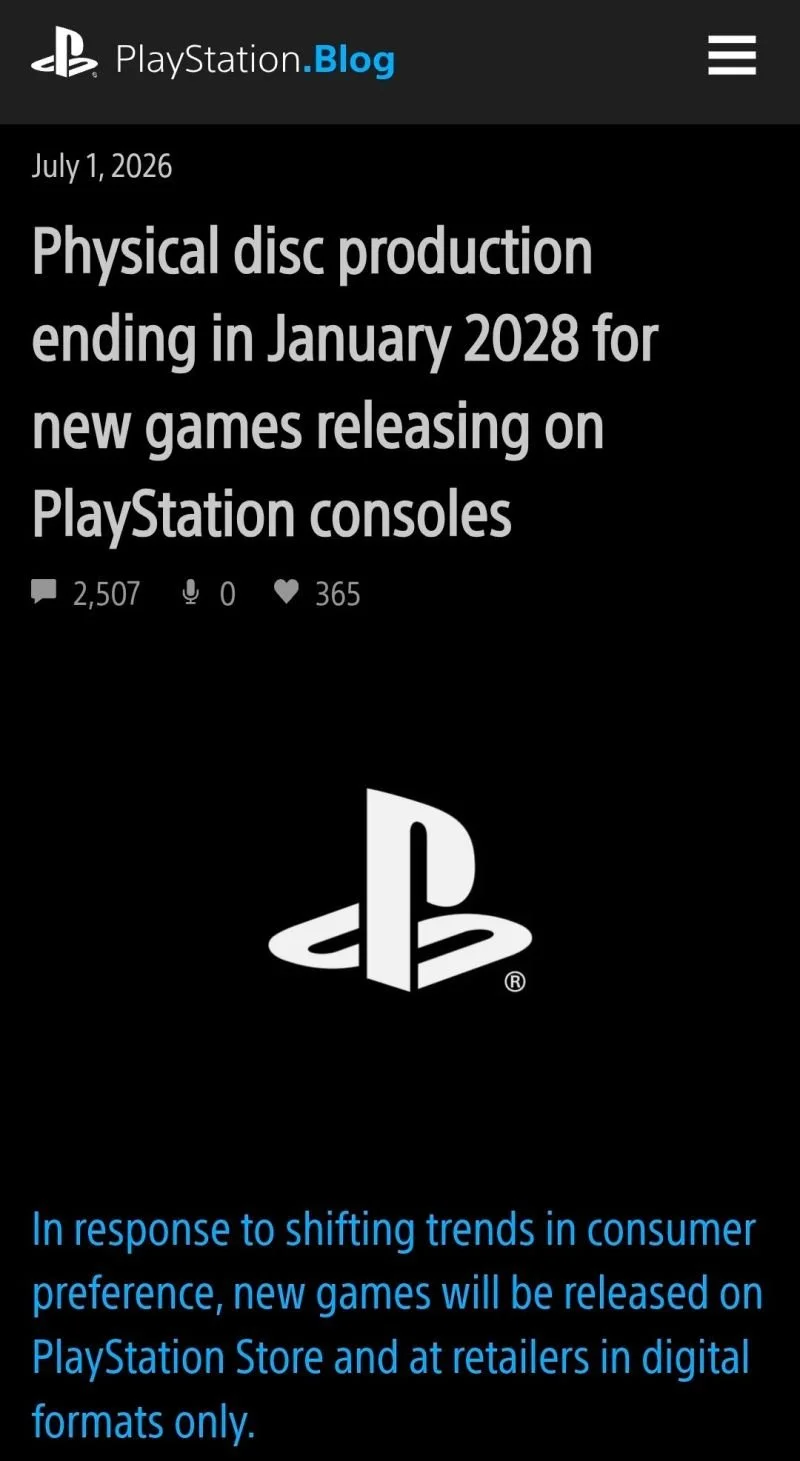
PlayStation announced on July 1st that the era of physical media for their flagship consoles was coming to an end. The responses were heard immediately, with thousands flocking to their respective platforms to voice their concerns. Gamers believed that it was less about the idea of physical media and more about the sense of ownership. This idea was not shared universally, as gamers began tearing into others about the need for physical gaming. The claim is that 85% of PlayStation sales are digital anyway, so most people were not even buying physical games. They believed Sony made this decision because of this fact, yet most fail to see how this number, while technically true, does not reflect an accurate representation of sales for physical media.
For years now, it has been known that digital game sales increase profit by around 25% in most cases. Between paying the market that made the sale (Walmart, GameStop, etc.) up to $15, the manufacturing and distribution itself averaging $3 per disc, and then paying the developers who made the game come to life, what is left for the poor old licensing company? (He asks sarcastically.) Well, $7 to $9 on average goes directly to the platform for what is known as platform royalties. If you ever wondered why gaming is so expensive lately, it is because everyone has their hands in the cookie jar.
These platforms learned years ago that a digital future would mean lower production costs and higher profit yields. This was painted to us as a future where games were immediately available, never sold out, and cheaper in the long run. In theory, this was a beautiful thought. A thought is all it would remain.
Digital used to be a choice gamers made, and a happy profit margin for platforms when they did. They had their own stores, and they were playing the marketing game like everyone else. Deals, free games, limited demos, and pre-order bonuses were all used to entice gamers to buy from them instead of making a physical purchase.
This choice was stripped from most gamers who were excited to play Resident Evil 9. Despite the hype surrounding the game. Despite the projected sales records. Despite the pre-orders. Resident Evil 9 was nearly impossible to find on a physical disc.
The pre-order system was set in place years ago to guarantee a copy of a game and the version of the game the player was choosing. The Deluxe Edition of Resident Evil 9 on all platforms sold out within a week of the announcement due to limited supply. Mind you, the Deluxe Edition of the game had only one physical benefit: a steelbook case. The lowest possible bar for gaming special editions, as most game stores cannot give them away even with popular titles.

A system was set in place to measure how many copies of a game or edition needed to be produced to ensure all fans who wanted one could have one without the production companies losing money by making too many. Not just on Deluxe Editions of Resident Evil Requiem, but the standard edition as well. Customers were constantly showcasing the emails stores had sent weekly, informing them of the cancellations. Cancellations on a game they had pre-ordered months before the game would even go into production.
Yet, even with all these issues and forced supply shortages, Requiem went on to sell 7 million copies since its release. Oddly, 55% were physical copies, and since almost every single copy sold, the value of these games has been retained, with opened boxes still selling for $40, which is rather high for a single-player Resident Evil experience almost a year after release.
Most people would think that this is a one-off case because nobody could predict how crazy sales would get for Resident Evil 9. Yet, there are tons of stories just like this surrounding games that still got limited releases within gaming stores. Split Fiction was sold in stores, with most GameStops only getting three copies of the game on release day. Imagine being the fourth person to show up for this highly anticipated co-op adventure.
With stories like this, it is hard to believe that 85% of gamers want digital-only because 85% of games bought on PlayStation are digital. Especially when you consider that games like Baldur's Gate 3 (2023 Game of the Year) were only available for physical editions through the developer's personal website for a very limited time. Or even Alan Wake 2 (Game of the Year nominee) did not receive a physical version until an entire year after its release. Even still, most games on PlayStation will never see a physical edition.
Misleading factors like this have led gamers to believe that half a section of gamers speaks for 85% of all gamers. Which leads us back to the blackout. Millions of gamers engaged positively with social media, showing excitement for the movement and joining in solidarity. What did they want? The right for gamers to have both digital and physical media. Somehow, this enraged a lot of gamers.
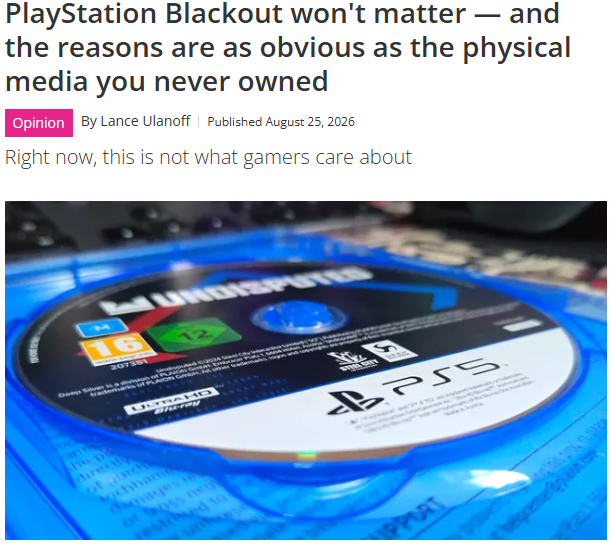
The article by Lance Ulanoff. Click the image to read more
Calling the movement pointless and useless, gamers not only did not participate in the blackout, which is completely fine and understandable, but they intentionally spent more money than they normally would during the blackout to cancel out those participating. For every gamer you had pushing for the continuation of physical media, you had roughly two gamers fighting for the multi-billion-dollar corporation to give them less. The math is not mathing, and we cannot understand why.
Articles written by companies like TechRadar say the Blackout won't matter. The author of the article, Lance Ulanoff, consults his video game expert, who, according to his article, is just a single game journalist. Who also happens to be the authors child. As if one game journalist's opinion is enough to speak for a movement that hundreds of thousands of gamers have rallied behind. Mind you, Lance himself admits in the article that he rarely plays games. So let me ask: how exactly are we supposed to take this as an accurate representation of the gaming community? According to the same article, PlayStation has more than 125 million active customers each month, yet the perspective being used to represent that massive audience comes down to one journalist and his 28-year-old child, who apparently serves as the resident "video game expert." Neither opinion is invalid, but when you're trying to dismiss a movement involving hundreds of thousands of people, using two voices, one of whom rarely plays games, hardly seems like a convincing sample of the community you're claiming to understand.
The idea that you can see the voice of your community online is a commonly held belief. Put your head out the window and listen to the crowds, and you will hear the voice of your people. This idea is completely shattered by the reality of social media algorithms. Every platform you are on is programmed to keep you engaged with content.
If you only watch videos about how much physical media sucks, why would it showcase any other idea to you? Gamers speak their minds online and are forcefully fed these ideas back to them to keep them watching, commenting, and sharing. A literal Ouroboros of engagement, designed to keep you online, watching their ads and lining their pockets. If you hear that hundreds of thousands of gamers are boycotting a large company, and all you see in return are gamers trash-talking them and working against them, how do you not realize the obvious echo chamber you are stuck in?
At the end of the day, major platforms like Sony, Microsoft, and Nintendo have made every decision to line their pockets with more while giving us less. The sad fact about it is, they could easily continue making physical media while making it more expensive than digital, and while collectors would be upset about that, it would be more understandable. It would actually make the term "Collector's Edition" make sense, as there would be something to collect.
They are only winning this battle because they are not the soldiers that have to fight back. Nobody wants to take away digital games (or digital licenses, I guess, is more accurate). We just do not want to lose physical editions, and I myself will never understand why that upsets so many gamers.

About the Author
For Lucian, gaming transcends mere pastime; it embodies a canvas of potentiality and future evolution. With an unwavering commitment to appreciating games not just for what they are, but for what they could become, he refrains from hasty judgments, seeking the inherent beauty in every project. In an industry often clouded by pessimism, Lucian strives to illuminate the positive aspects, fostering a culture of optimism and appreciation. Whether engrossed in intense PVP sessions or immersed in the narrative depths of a single-player story, he finds joy in both the communal experience and solitary exploration. As long as there's a game to play and a friend to share it with, Lucian is content beyond measure.